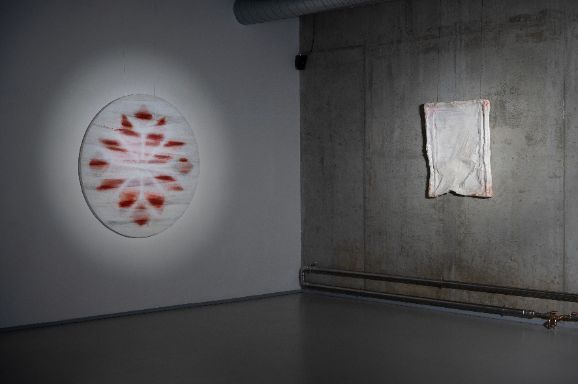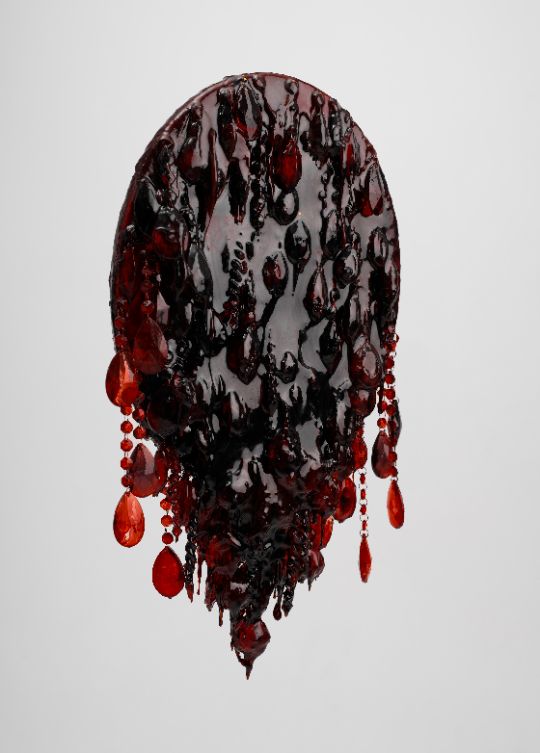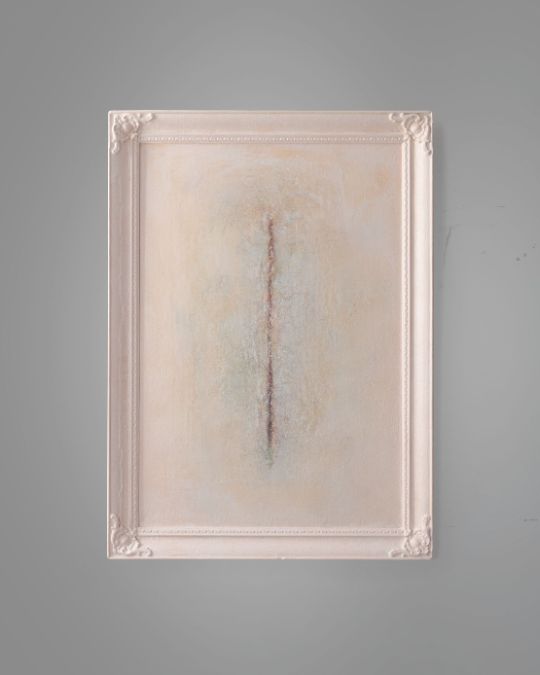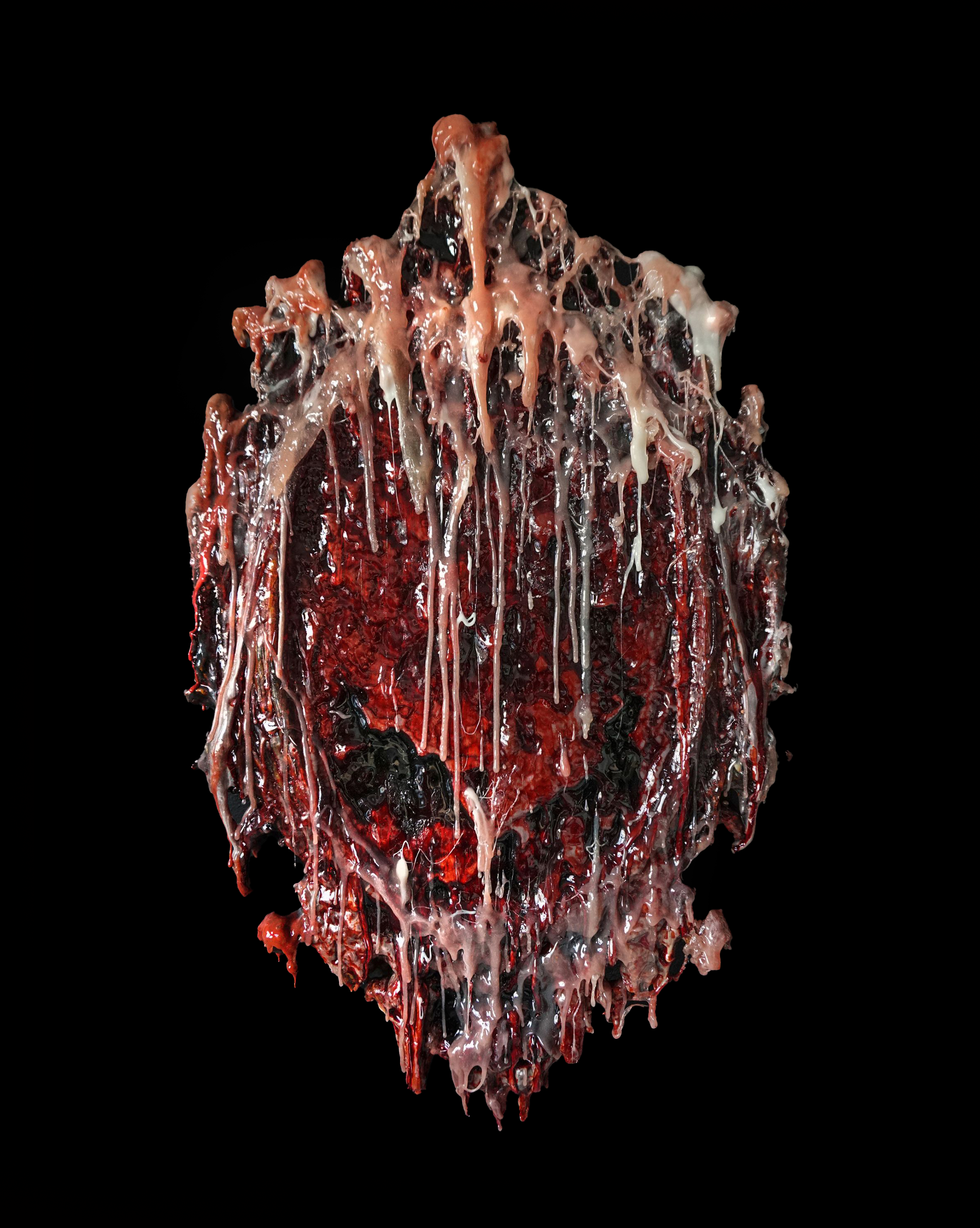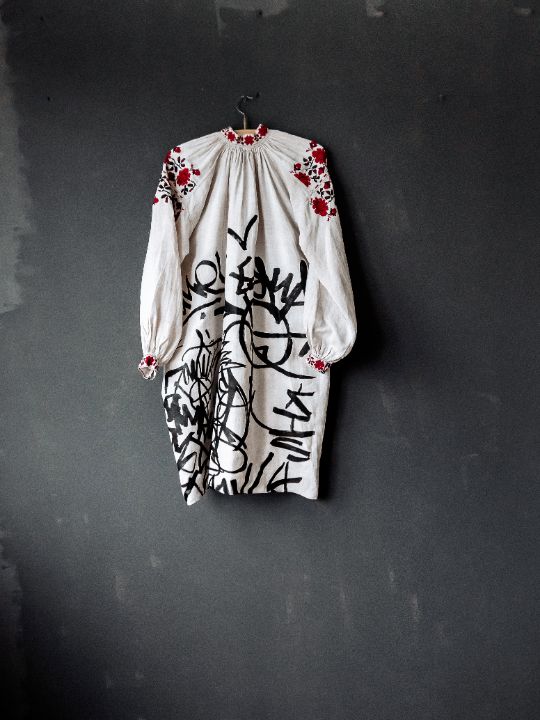
Site-specific installation, 2026
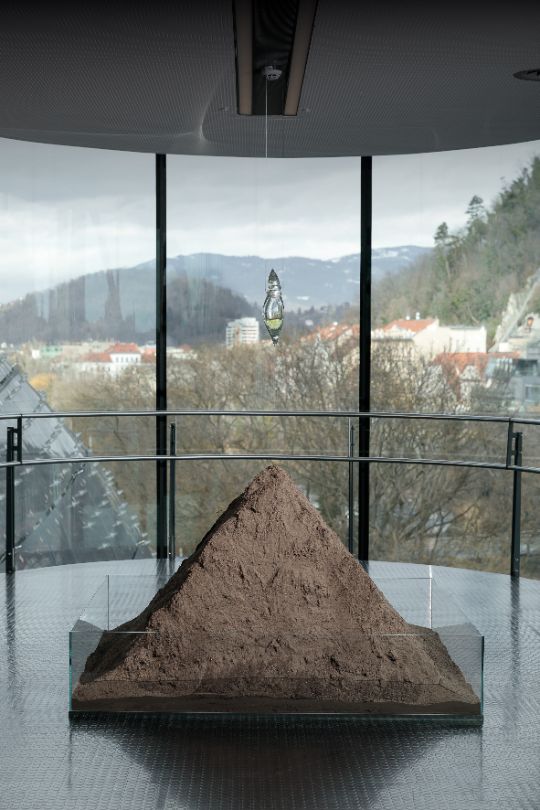
Materials: Belarusian soil, soil extract in a hand-blown glass flask, glass, textile, sound
Kunsthaus Graz, Needle
Graz, Austria
ZIAMLIAČKA
My mother dug up 225 kilograms of soil from the plot where our ancestral home stood. Now there is only a void. The soil crossed borders under constraint, with great effort. My ritual of intimacy with what is lost is radical: I am regaining a sacred space through enfleurage. I extract the scent from the soil, forcing fat and ethanol to absorb the aroma of what cannot be taken away. This extract is a form of my memory, an attempt to regain the lost peace.
By the end of 2024, the number of forcibly displaced people worldwide had reached 123.2 million. My glass bottle is their shared silent prayer for the soil that no longer holds them.
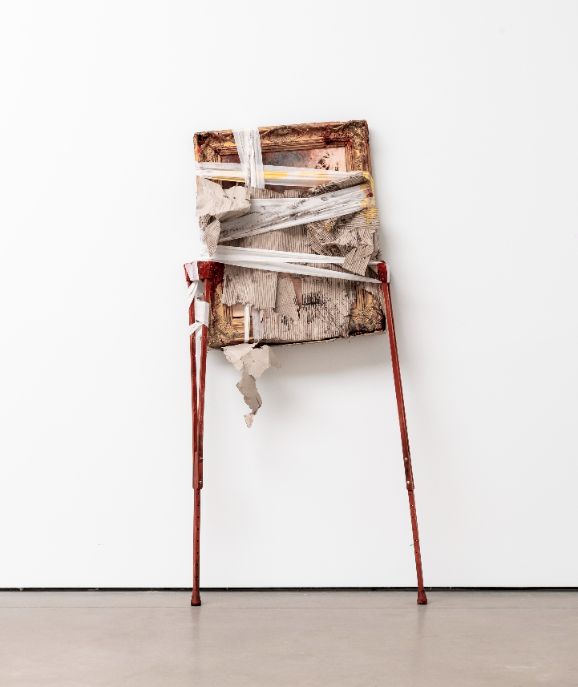
Oil on canvas, wooden frame, cardboard, crutches, bandages, 2026
Homeless
The work transforms a fractured frame on crutches into a living body. Bound with bandages and cardboard, it physically embodies the trauma, vulnerability, and precarious endurance of forced exile.
object / sculptural painting
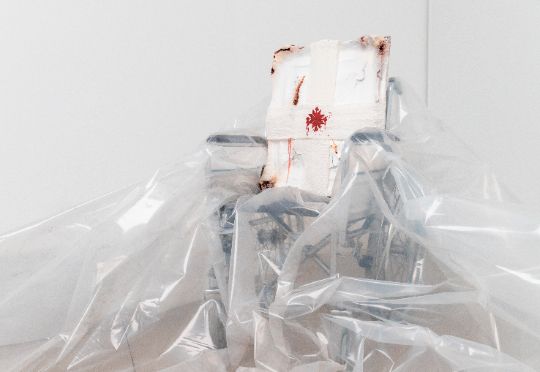
mixed media on plaster-bandage form: oil, acrylic, polymer coating, fabric bandage with embroidery; wheelchair, plastic sheeting, 120 × 70 × 90 cm, 2025
Status Quo
The bandages simultaneously try to hold a collapsing form together and conceal a wound that nevertheless seeps through the national symbol. A transparent protective film, like a veil, permeates the structure and extends beyond the chair: how long can the material hardness of the support sustain such fragility?
Belarus: here, pain is preserved, and the future has been put on pause. This work is saturated with anxiety—the only affect that never deceives.
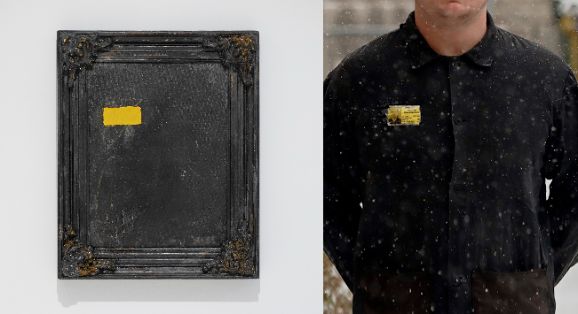
oil on canvas, 86 × 69 cm, 2024
Political Prisoner Painting
As of November 20, 2024, nearly 1,300 people in Belarus have been officially recognized as political prisoners, and human rights activists have documented over 7,000 individuals involved in politically motivated criminal cases — 6,113 of whom have already been convicted. It is clear that these numbers do not encompass all those subjected to political persecution in Belarus in recent years.
In Belarus, political prisoners are often subjected to not only physical but also psychological torture. One form of such repressive practice involves special yellow tags used to mark political prisoners. These tags signify the prisoners’ “special status,” making them even more vulnerable within the penitentiary system. Political prisoners marked with these tags are automatically subjected to heightened surveillance, harsher detention conditions, and additional pressure from prison authorities.
Former political prisoner Viktor Parkhimchyk, who fled Belarus for Poland in November 2022, managed to secretly bring with him the prison uniform he wore during his detention. Viktor now wants the world to see it. The international community must recognize the scale of repression in Belarus, and every detail, including these tags, helps to reveal the extent of violence in Belarusian prisons.
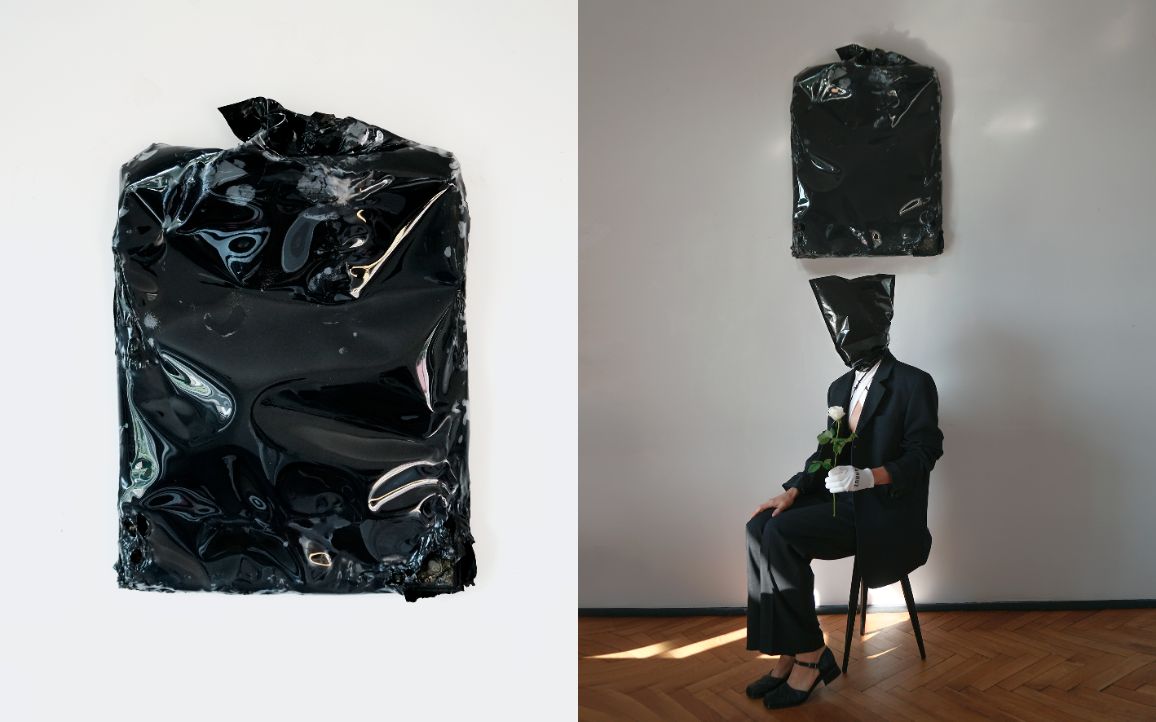
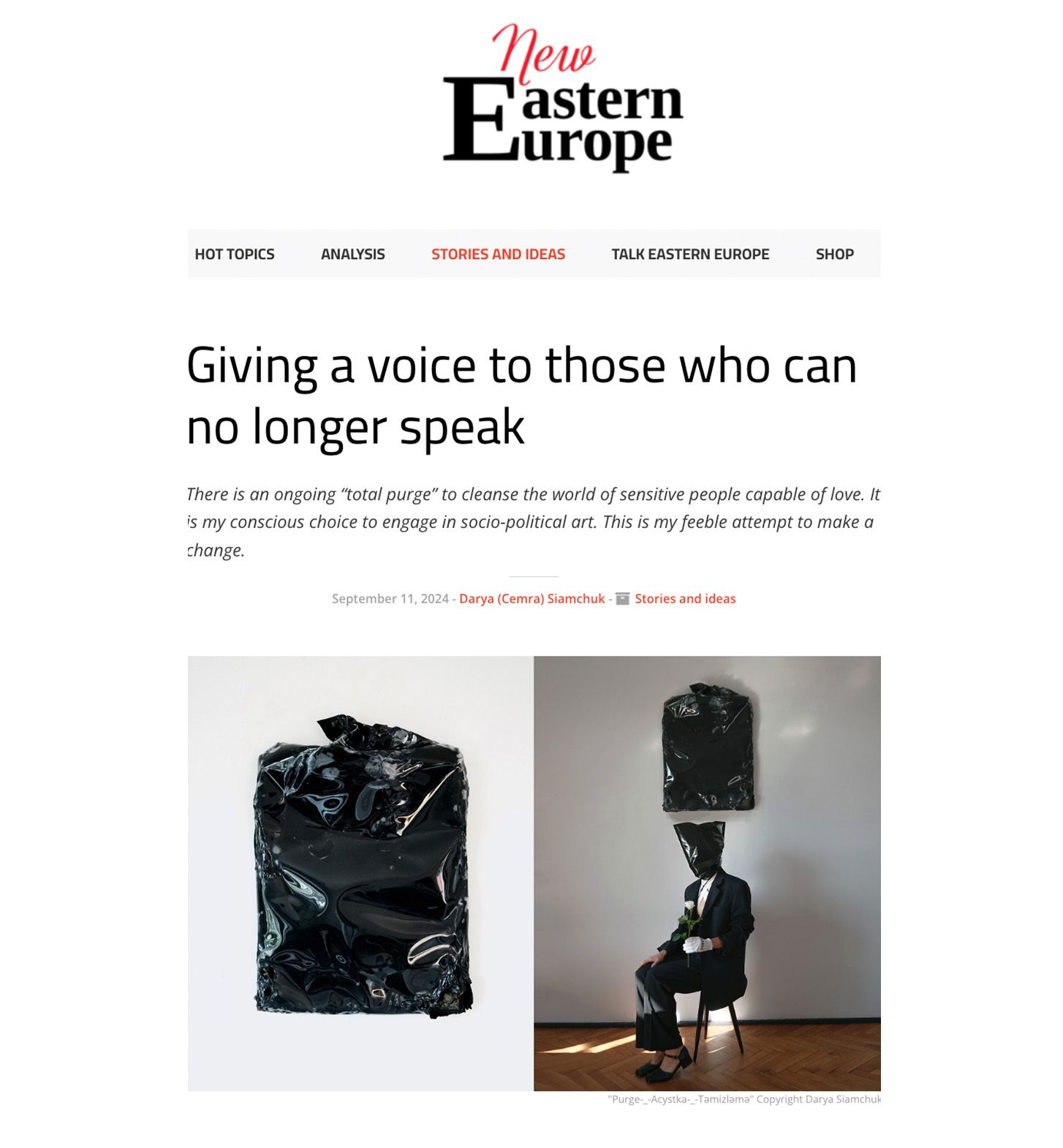
hard plastic in wooden frame, 90 × 65 cm, 2024
Purge / Ačystka / Təmizləmə
The painting “Purge” explores the universality of the experience of political repression, highlighting how mechanisms of oppression operate regardless of where they take place. Based on the story of an Azerbaijani scholar unjustly accused of treason, this work brings to the forefront not only his personal struggle but also similar tragedies occurring in Belarus, Azerbaijan, and other countries where authoritarian regimes suppress freedom of thought and expression.
mixed media on canvas, 96 × 76 cm, 2025
Lack
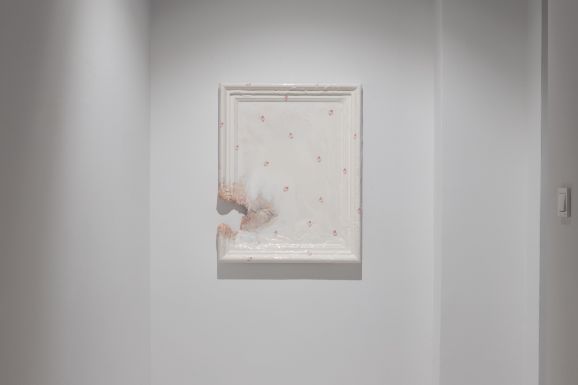
The smooth surface is an illusion of a coherent self. The rupture is an intrusion of the Real—what resists description and upsets order. Yet it is precisely through this fissure that new energy emerges: the possibility of transformation.
Lack is not a depiction of breakage; it is a gesture that shows how a crack can be a beginning. What is missing shapes us more powerfully than what is present. You are not what you have, but what you lack.
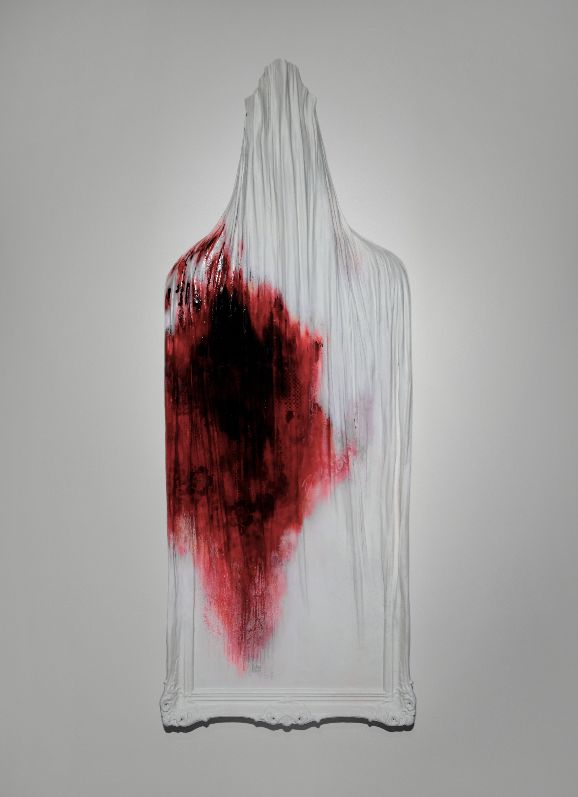
plaster bandage form, pastel, oil, resin coating, 122 × 102 cm, 2024
Amputation of Roots
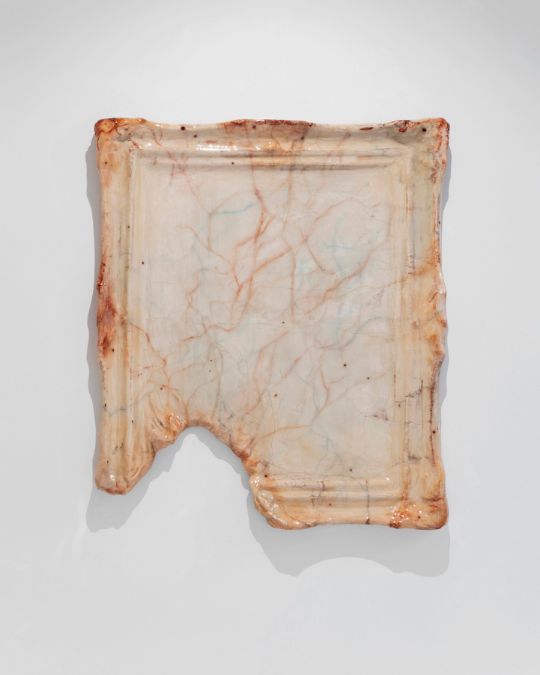
The severed part becomes a symbol of what can no longer be integrated into the present — a painful yet necessary break from the past. But the wound is not only absence; it is also a beginning. In the space of removal, a more complex and shifting identity can emerge.
Amputation becomes an act of resistance and survival — a testimony to the pressure of systems that demand silence, and to the resilience of those who persist.
oil on canvas, 120 × 100 cm, 2025
The Consequences of Love
plaster bandage form, pastel, resin coating, 122 × 102 cm, 2024
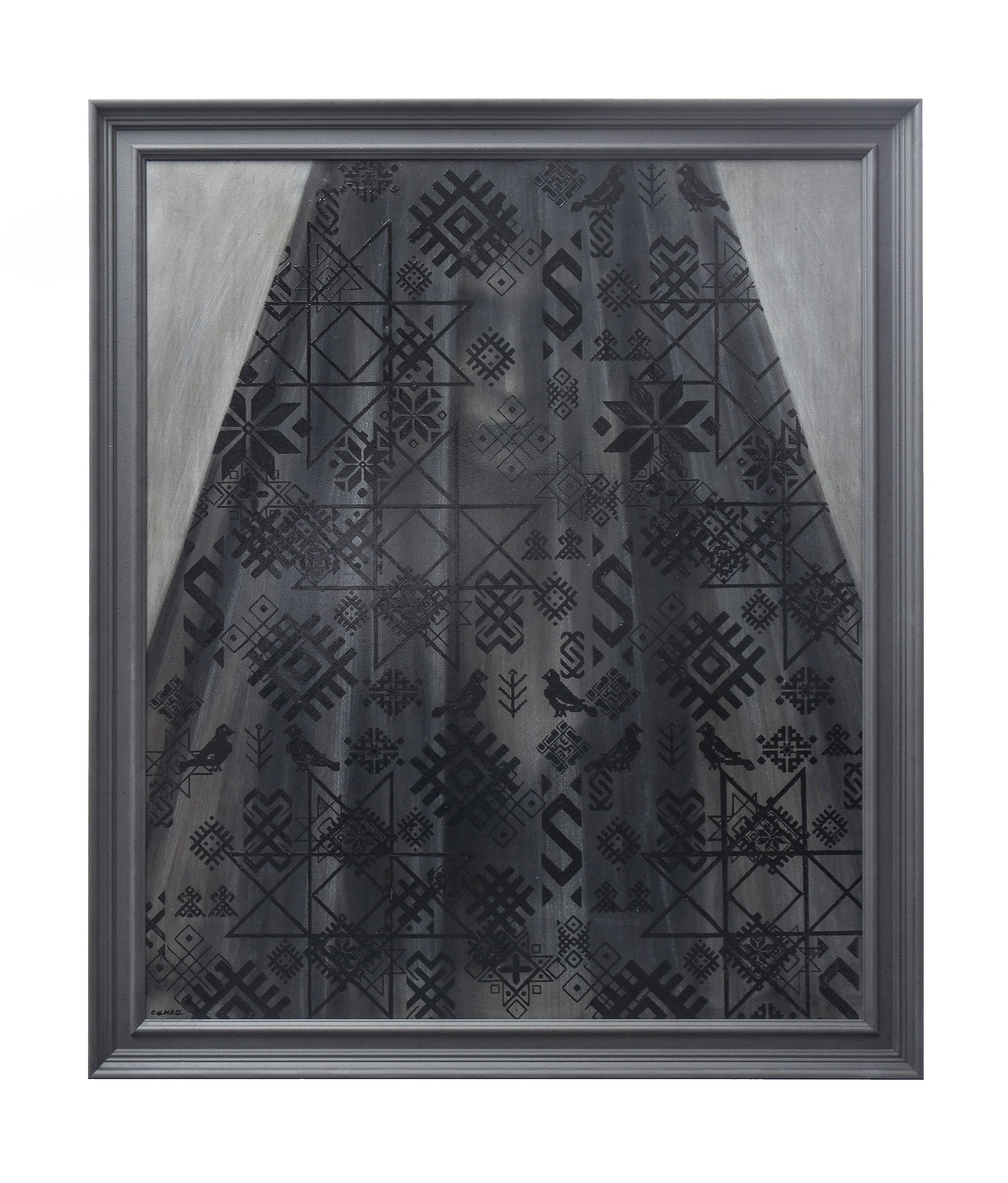
Vycinanka (ad slova cisk)
In this work the delicate ornamental language of vycinanka, rooted in folk ritual, is reimagined as bruises on the body. Decoration becomes an archive of pain: the blue discolouration left by pressure serves as a visible trace of historical violence. The picture plane operates as a living skin, where ornamental beauty lays bare experiences of political oppression and loss.
Belarusian vycinanka has been inscribed on the UNESCO List of Intangible Cultural Heritage.
plaster bandage form, pastel, oil, resin coating, 66 x 50 cm, 2024
Spleen
This work is dedicated to my removed spleen — a silent organ with a loud cultural echo. In English and French literary traditions, “spleen” became synonymous with melancholy, ennui, and existential fatigue. To be “a man without a spleen” once meant to be cured of illusion, anchored in reality. But what does it mean to carry its absence in the body?
Here, the scar becomes both wound and witness — a visible trace of an invisible transformation. It marks not just a loss, but a shift: from fragility to resilience, from silence to form. The body, interrupted, begins to speak.
oil on fabric, framed canvas, 113 × 85 cm, 2024
Cocoon
I interpret “cocoon” as a metaphor for inner struggle, recovery, or evolution. It prompts reflections on freedom, pain, and the process of transformation.
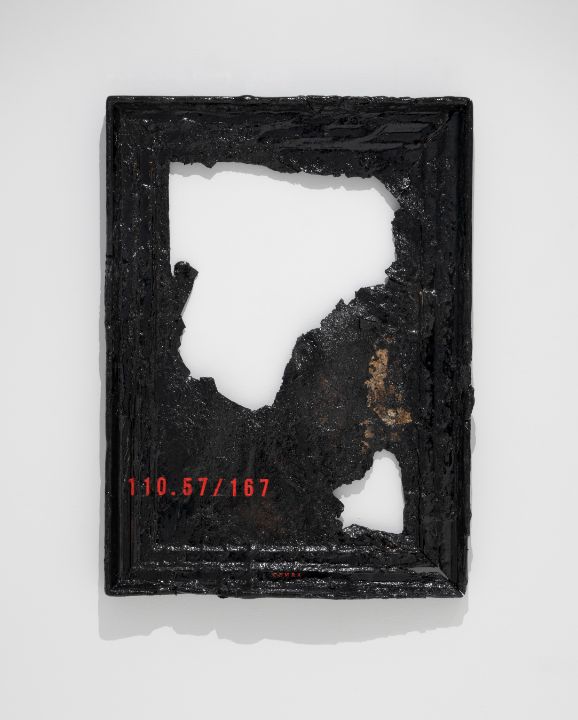
Canvas, wood, fire, oil, resin coating, 110 × 80 cm, 2024
Inventory Number
The burned surface of the painting and the inventory number serve as a metaphor for the attempt to comprehend the structure of meaning and to divide the world into “understandable” categories.
This work is a call to reflect on the nature of control and freedom, and on how easily numbers can lose their connection to real people and their stories. The “inventory number” stands as a testament to lost hopes and freedoms, but it also serves as a reminder that each of us has the right to ask questions, to seek answers, and to fight for our own story.
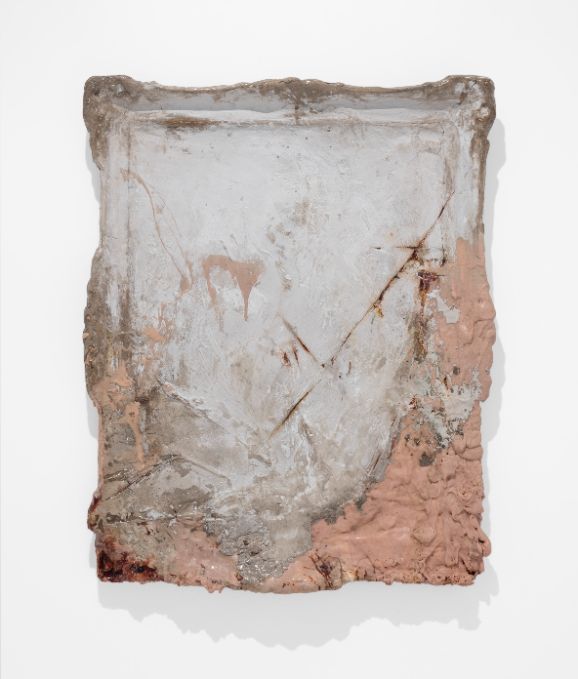
mixed media (cement and silicone), 96 × 76 cm, 2024
Sensitivity
The contrasting colors — cool gray and warm pink — highlight the complexity of emotional states. Gray conveys resilience and pressure, while pink evokes openness and life. Their combination creates visual tension, inviting contemplation of how external strength and internal sensitivity shape our essence, and how new strength and wholeness arise from apparent fragility.
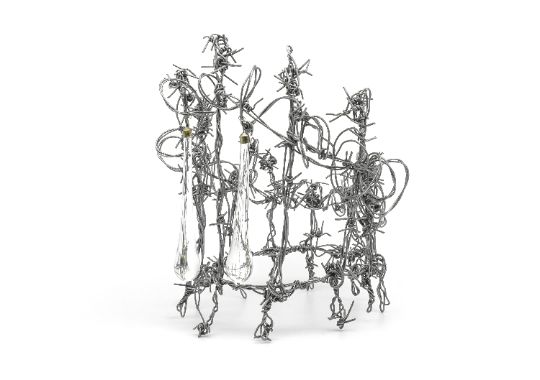
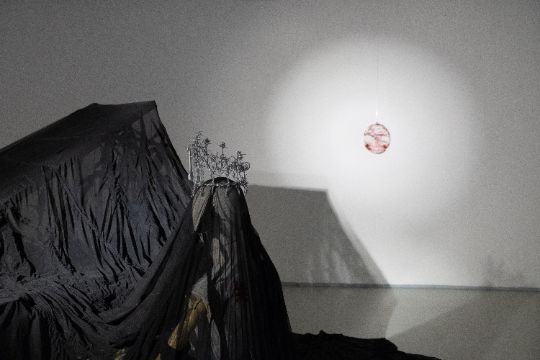
barbed-wire crown with two suspended glass tears, 25 × 23 cm, 2022
Crown of Sorrow
The piece embodies a stark metaphor of pain, confinement, and dignity that remains unbroken.
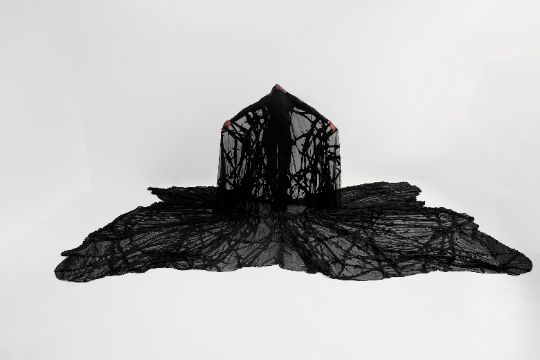
delicate net fabric, 550 × 550 cm, 2022
Captivity
550 X 550 сm.
Barbed wire crown with two large glass tears.
Dedicated to Belarusian political prisoners. With this work, I show my solidarity and express admiration for the fortitude and dignity with which people are going through this terrible suffering. To Belarusians, who were captured in prison for their humanity in the struggle for freedom.
mixed media, 31.5 × 27.5 cm, 2023
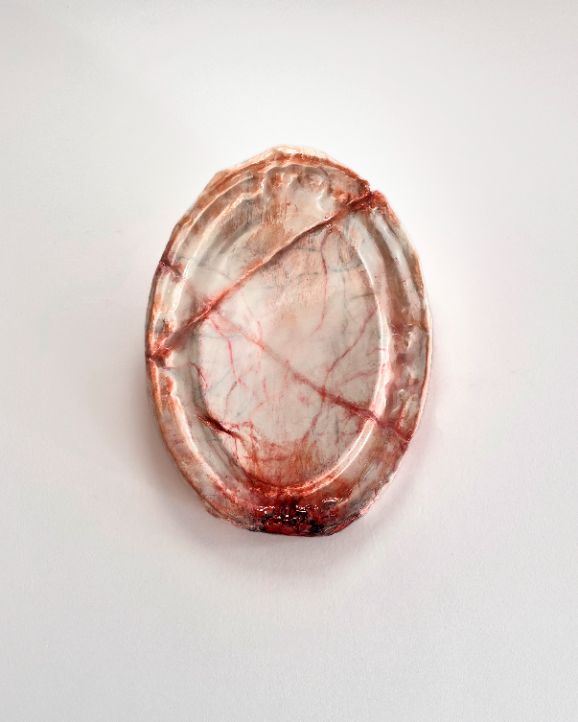
Veins of Stone
our blood's coagulability increases.
This reaction is linked to our body's primal response to injury threats, where thicker
blood would help in stopping bleeding.
oil on canvas, tar, 102 × 81 cm, 2022
Maiming
mixed media, 194 × 77 cm, 2023
Alive / Жыве
For Belarusians, the signifier "Zhyve" (Alive) is linked to the patriotic slogan "Zhyve Belarus" — "Long Live Belarus." This slogan has a long history tied to the anti-colonial aspirations of the Belarusian nation, which today are directed against Lukashenka's brutal regime and Russia's neo-colonial influence. Reduced to "Alive," the work recalls Derrida's concept of "hauntology" — the ontology of a ghost. This spectral ontology captures a negativity, the very "understanding that it is precisely the blockade, the impossibilities, the displacements stemming from negativity..." Such a "phantom-Belarus" always returns; the ghost is the impossibility of Belarus, simultaneously absent and present. The ghost, transcending the dichotomies of life and death, presence and absence, past and present, is what remains, returns, and never dies. Resonating with Derrida's "democracy to come," the figure of the Belarusian ghost is not devoid of hope. After all, it always returns and reminds us of its presence in absence. It haunts — in its sublime form.
plexiglass mold, oil, resin coating, 85 × 65 cm, 2023
Sores
plaster bandage, oil, 94 × 72 cm, 2023; reworked 2025
PAINting
A year ago, I took a vow of abstinence from alcohol and jewelry — an ascetic gesture made for a wish that has not yet come true. It was a renunciation of the external in order to focus on the internal. For a year I neither drank nor adorned myself. This painting remained the only one without a home after the Lazaret exhibition, and I decided to gift it my jewelry — even my grandmother’s earrings — so that it might become more beautiful, loved, and accepted. Among these ornaments are pieces of Czechoslovak costume jewelry, some more than sixty years old. Produced in the 1950s–1970s, such pieces are increasingly regarded as collectible, as production on this scale and of this quality no longer exists.
bandage on oil, 140 × 140 cm, 2022
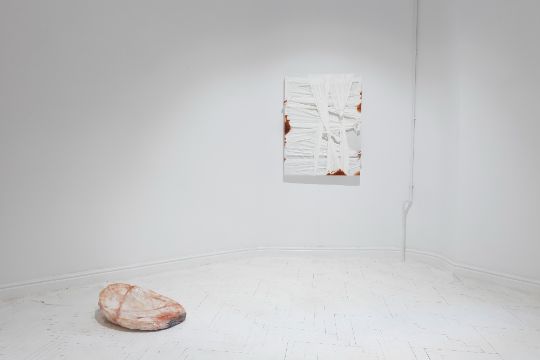
Sign of pain
Creating this painting required more than 100 packets of bandages, which I rewrapped and saturated with varnish across all layers. In my art, the national symbol breaking through the bandages signifies the resilience of the Belarusian people, acknowledging our collective pain. This work is an homage to our shared struggles, embodying the spirit of resilience and the hope for healing and liberation. The symbol serves not just as a testament to our hardships, but also as a beacon of our enduring strength and unyielding determination. Through my art, I aim to tell our stories, give voice to our experiences, and contribute to our shared narrative of resilience, triumph, and hope.
canvas, oil on bandage, 85 × 75 cm, 2022
Victim
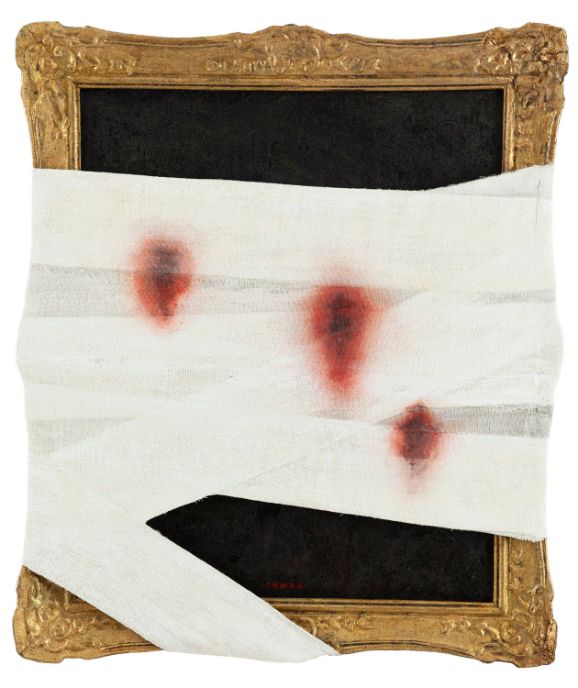
In bandages, even if they are dense, there is always a splash of blood. The common theme that connects my works is the entanglement of various traces marked by blood and ruptures of tissue. These materialized wounds are connected to memories of detachment from the home or homeland. Reflecting on the experience of homelessness and forced refuge, my works demonstrate the never-completed, non-linear, and still-bleeding process of healing that transcends the bounds of chronological time.
This artwork has a special story. I started it in Belarus at a moment when I was forced to evacuate urgently due to political repression. Later, while I was in Kyiv, I received the painting and completed it within two months during my stay there.
When the war began, I had to flee once again — I left all my works in the bathroom of a rented apartment and went to Poland. Later, during wartime, I managed to retrieve “The Sacrifice” along with two other paintings — they were sent to me from Kyiv to Poland.
This painting has traveled a long road with me.
plexiglass mold, tar, oil, 85 × 65 cm, 2022
Under the sky of Belarus
“I see in his gaze a piercing look directed at humanity — a humanity that has failed to learn from the Holocaust. I see in him reproach and sorrow, acceptance and departure, alienation and denial.”
— Written from prison by someone who saw this work at the exhibition.
сanvas, glass, tar, oil. 75 × 40 cm, 2021
Bullet — A Fool
A materialized metaphor for blind violence. The bullet hole. Resin and glass imitate living, "wet" matter, frozen at the moment of impact. "Black blood"—a substance that does not flow, but crystallizes. The "fool" bullet acts blindly, yet it leaves a mark that is impossible to ignore.
93X64 cm. Oil on canvas. 2022
Mark
“Scars are stronger than the skin itself; they are better able to withstand impact.”
— Clarissa Pinkola Estés
gypsum, canvas, epoxy resin, 80х50 cm, 2020
Rape
Dedicated to the Belarusians who were raped by the government.
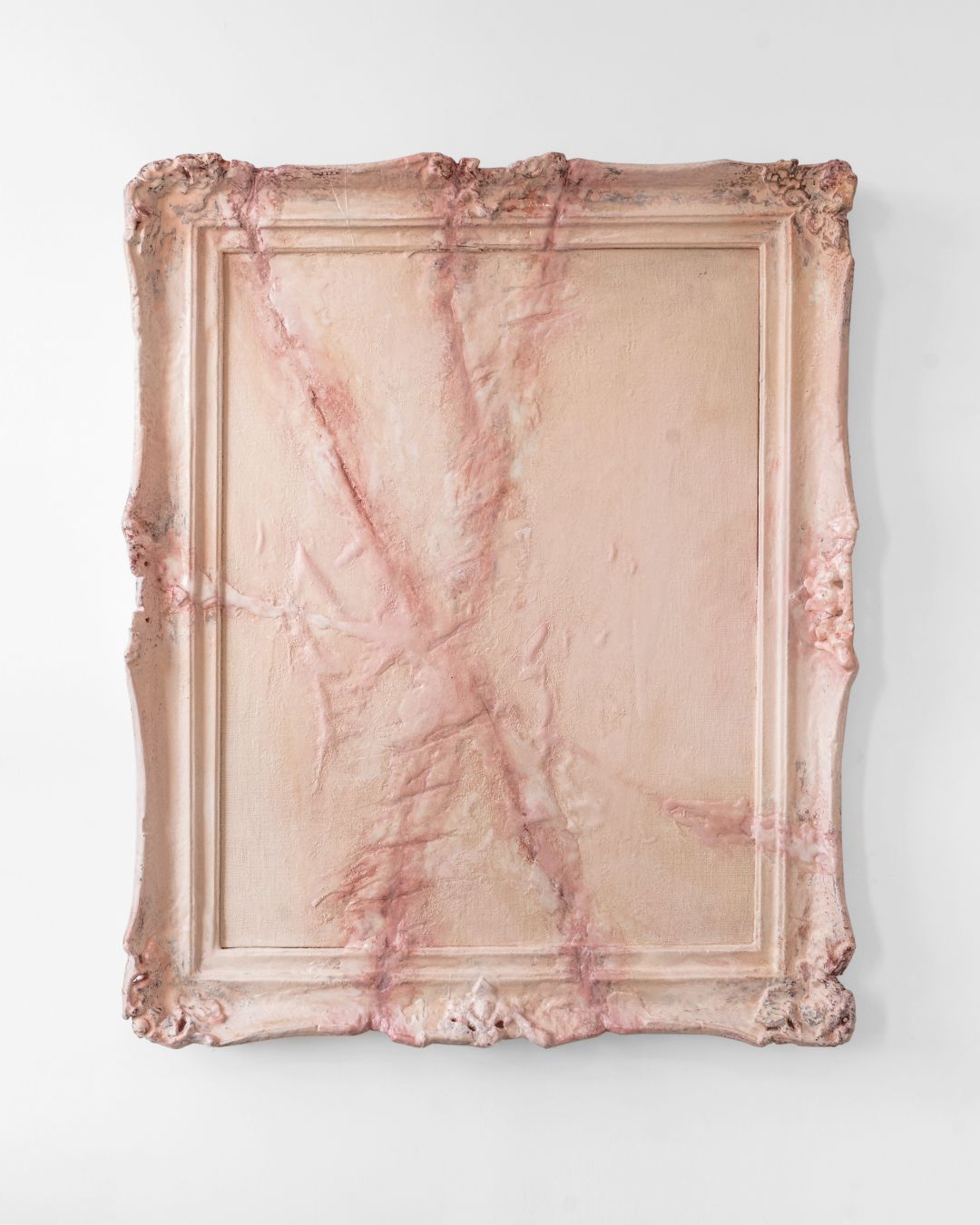
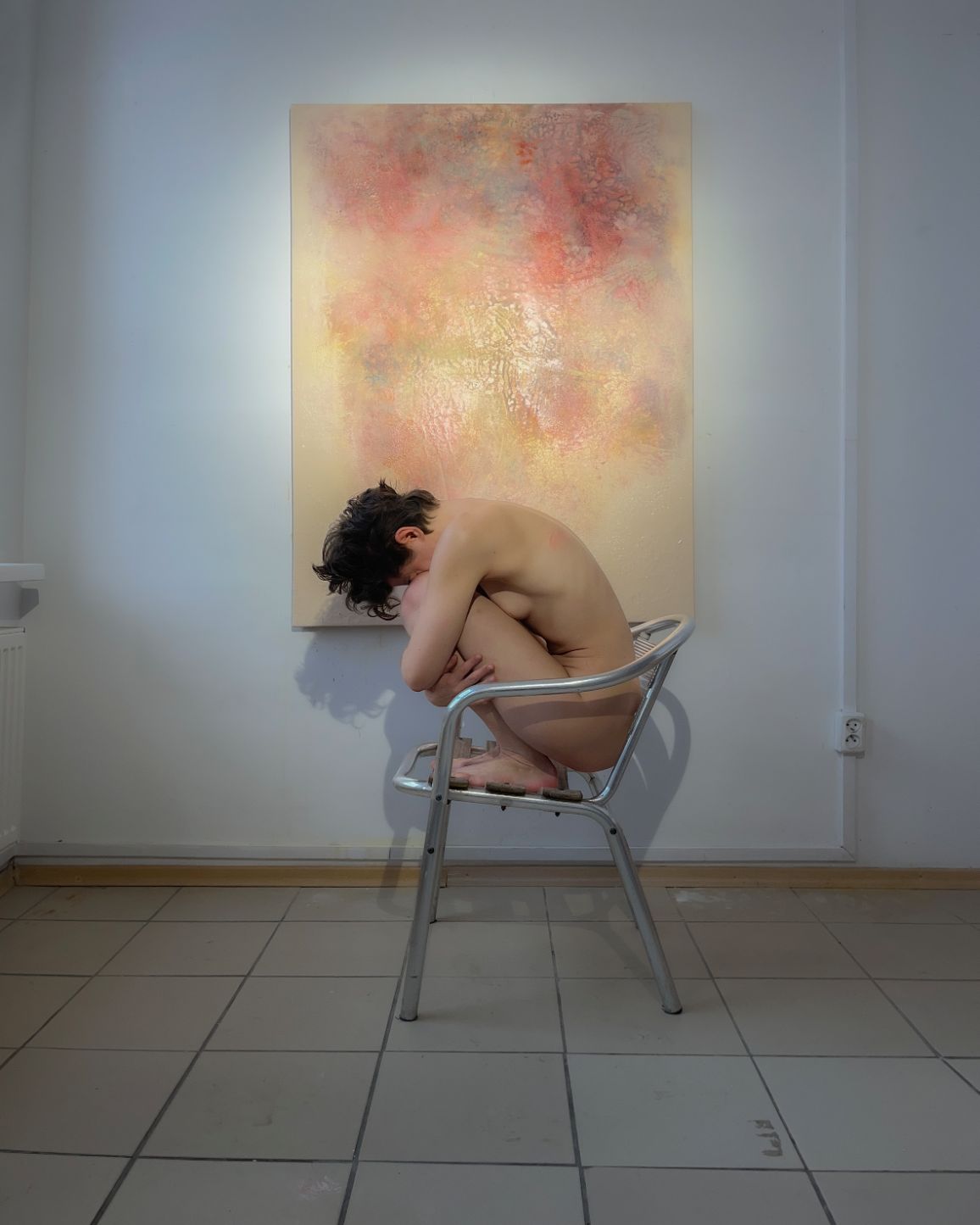
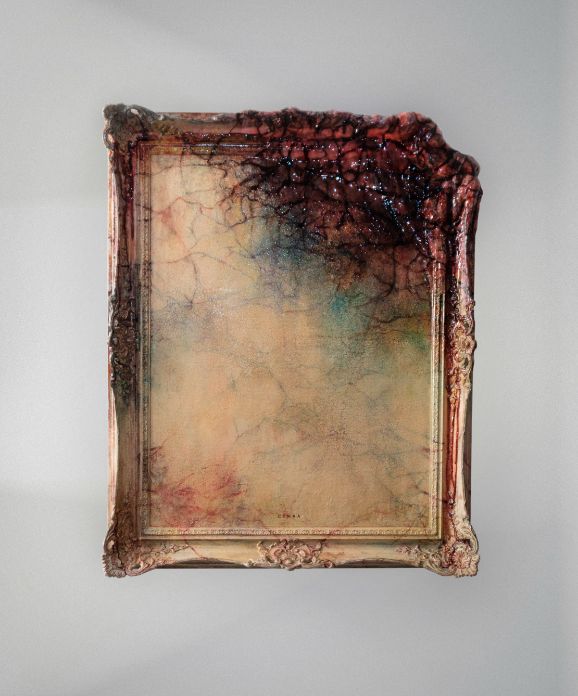
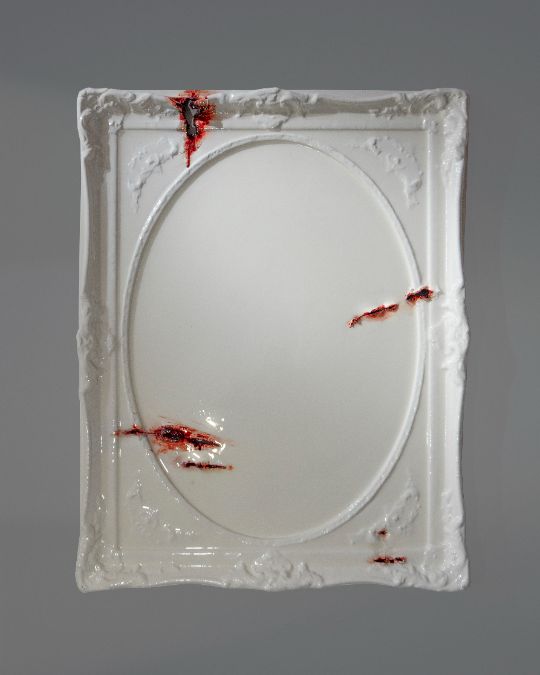
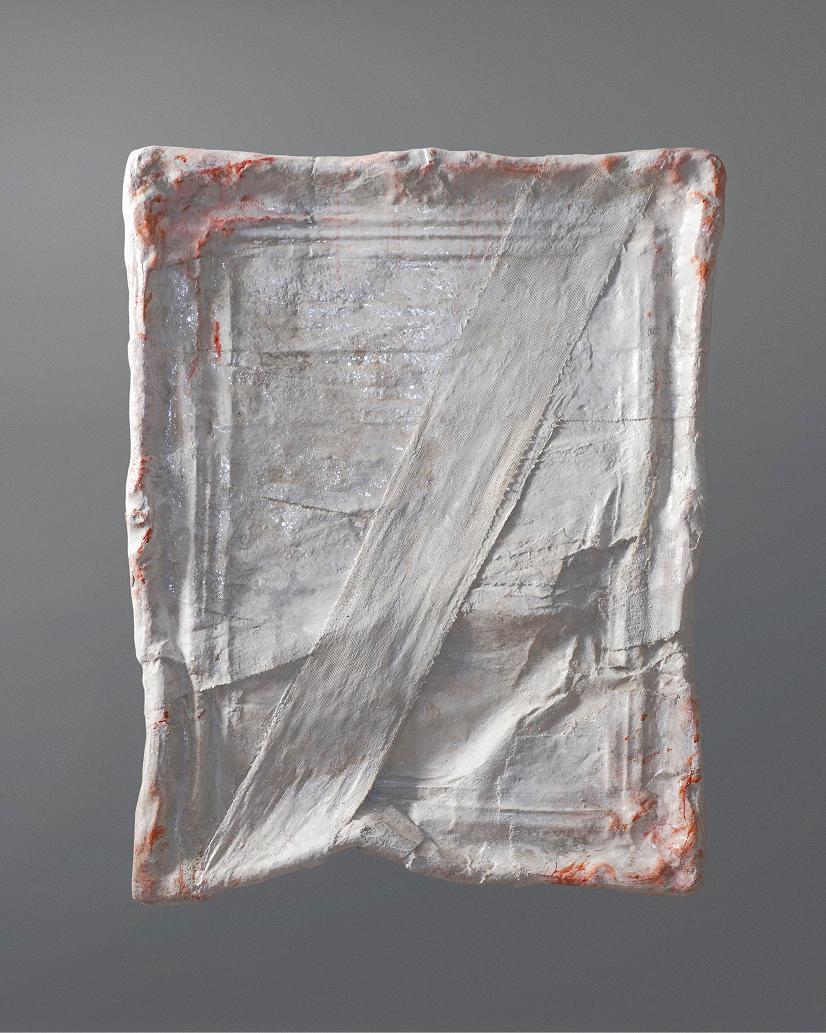
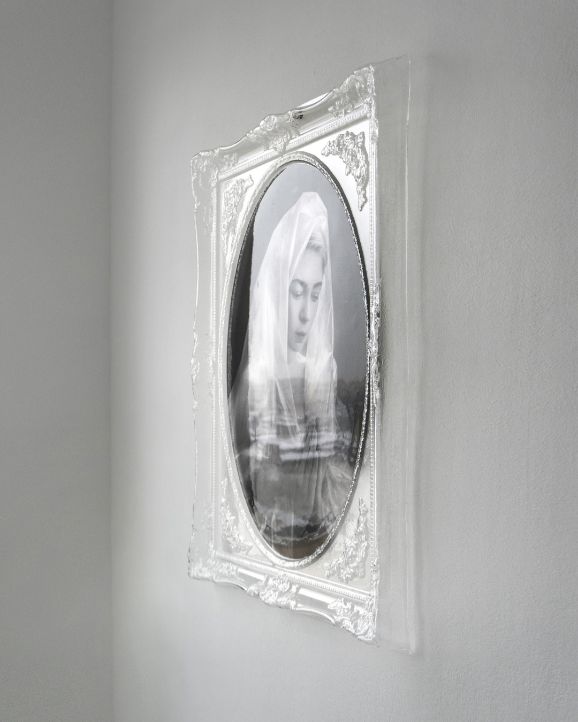
In my practice, I refuse to perceive the canvas as a flat surface, treating it instead as a living body—with shoulders, bones, and scars. Using plaster bandages, resin, and oil, I create an “epidermis”—a structural skin that physically records trauma and care. Here, the act of bandaging functions biopolitically: it is simultaneously a medical intervention and a formal artistic strategy of absolute empathy, designed to protect, expose, and stabilize the fragile form.
After my forced displacement from Belarus in 2022, my works bear witness by forming a “collective shell,” archiving the shared memory of political violence. Avoiding direct narrative, the surface itself becomes a physical archive of trauma. In my recent project Ziamliačka, this shell extends to the earth itself, where I explore the profound pain of losing one’s native soil and of violent uprooting. For this work, I carried soil across the border and extracted from it the scent of my homeland.
My projects and sculptural paintings do not merely illustrate pain—they physically embody it. By integrating wheelchairs, traditional ornaments, elements of prison uniforms, and bandages into my works, I confront the viewer with the tactility of the scar, transforming individual vulnerability into a monument of collective endurance.
Solo exhibitions
2026 – ZIAMLIAČKA, Kunsthaus Graz, Graz, Austria
2025 – FRAGILE, MAD Gallery, Poznań, Poland
2023 – LAZARET, Beseder Gallery, Prague, Czech Republic
2023 – LAZARET, Museum of Free Belarus, Warsaw, Poland
2021 – ACHING, A&V Art Gallery, Minsk, Belarus
2020 – UNTITLED, Art-Belarus Gallery, Minsk, Belarus
Group exhibitions
2025 – The Arrows of Resilience: Reimagining Saint Sebastian, MAD Art Gallery, Warsaw, Poland
2023 – Charity Auction for the Humanosh Foundation, Exhibition of works by Belarusian, Ukrainian, and Polish artists, Piękna Gallery, Warsaw, Poland
2023 – Where am I. Exhibition of contemporary Belarusian art, Montenegro European Art Community Gallery, Budva, Montenegro
2023 – Who Owns the Land: Art as agent of expression conflict, statelessness, diaspora, coloniality, THE PINNA Gallery, exhibition online, London, England
2021 – The Autumn Salon, National gallery Palace of Arts, Minsk, Belarus
2020 – Art-Minsk the international art festival, National gallery Palace of Arts, Minsk, Belarus
2019 – The Autumn Salon, National gallery Palace of Arts, Minsk, Belarus
2019 – Triennial of Young Artists, National gallery Palace of Arts, Minsk, Belarus
cemraart@gmail.com